
A growing threat affecting real people
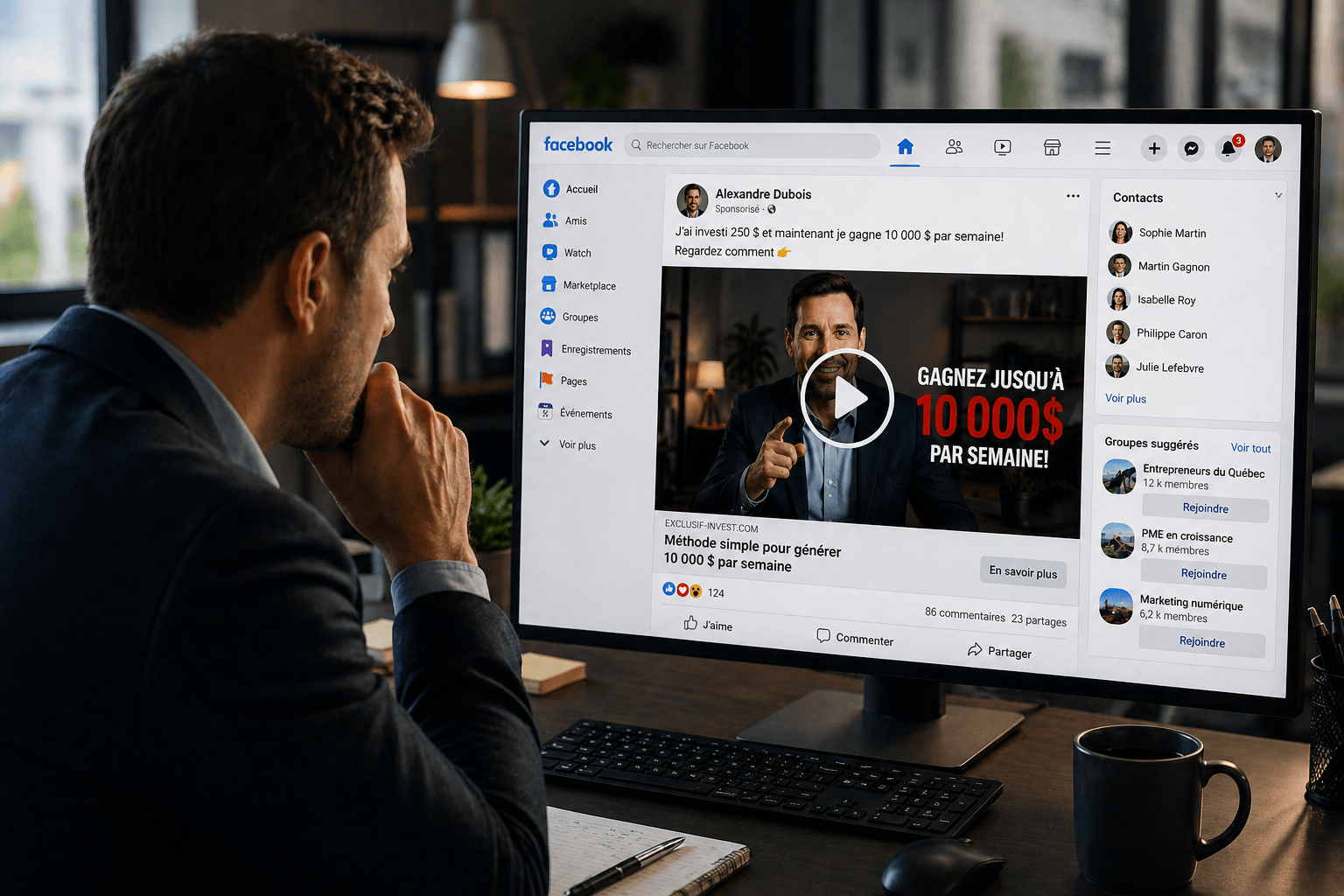
In Quebec, several public figures have recently seen their image and identity misused in fraudulent online advertisements spreading across social media.
TV host Ève-Marie Lortie is one striking example. Fraudsters used her photo, voice, and even first-person messaging to promote fake weight-loss products. The content was so convincing that some users believed it was legitimate… and ended up sharing their financial information. (Source : Journal de Montréal)
She is not alone. Nutritionist Isabelle Huot has also been targeted in manipulated videos where her likeness and voice were used to sell “miracle” products. In some cases, Quebecers were willing to spend hundreds of dollars, convinced the offer was genuine. (Source : Journal de Québec)
A similar situation occurred with Marie-Claude Barrette, whose identity was used in fraudulent cryptocurrency investment ads. (Source: Journal de Québec)
Across all these cases, one thing stands out: the content looks real enough to deceive users… and often circulates for days before being taken down.
This is no longer an isolated issue. It has become systemic.
A bill aimed at regaining control
In response to the rise of these scams, the Quebec government is preparing to introduce a bill aimed at strengthening the fight against online identity theft.
The goal is to equip organizations such as the Office de la protection du consommateur and the Autorité des marchés financiers with stronger tools to act more quickly, particularly when it comes to removing fraudulent advertisements from digital platforms.
For years, victims have faced a frustrating reality. Reporting fraud was often slow, complex, and ineffective—especially when perpetrators operated outside Canada.
This bill aims to correct that imbalance and provide real enforcement power.
However, as necessary as it may be, it should not create a false sense of security.
A political response to a technological problem
Today’s fraud schemes rely on technologies that are evolving at an incredible pace. Deepfakes, for instance, can replicate a person’s face, voice, and tone with a level of realism that makes detection difficult—even for trained eyes.
In many reported cases, victims say they believed the content because it appeared completely authentic.
That is the real challenge.
Laws can regulate, penalize, and accelerate certain processes. But they cannot slow down the evolution of fraud tools or eliminate operations conducted internationally.
In other words, the legal framework may improve… but the risk continues to grow.
Why SMEs are especially vulnerable
These types of scams are no longer limited to public figures. They are increasingly targeting businesses, especially small and medium-sized enterprises.
A local company with a strong reputation, an active social media presence, and visible leadership becomes an ideal target. Fraudsters only need a few images, a recognizable tone, or public content to create convincing fake communications.
Unlike large organizations, SMEs rarely have the tools or resources to monitor this type of misuse in real time. As a result, fraudulent content can spread undetected.
When it is discovered, the consequences can be immediate. Customers may be misled, confused, or lose trust. In some cases, the business is forced to manage a crisis it never caused.
What this bill really changes for businesses
Even though it has not yet been adopted, this bill signals a significant shift in expectations.
It makes it clear that digital fraud is being taken seriously and that enforcement mechanisms will be strengthened.
This means businesses will increasingly be expected to respond quickly when incidents occur and to demonstrate a certain level of vigilance regarding their online presence.
At the same time, digital platforms may face greater pressure to act. However, response times and effectiveness will still vary.
It is important not to draw premature conclusions. The bill improves the framework, but it does not replace internal safeguards.
A necessary shift in mindset
This evolving landscape calls for a change in how SMEs approach cybersecurity.
It can no longer be viewed solely as protecting IT systems. It now directly impacts brand image, reputation, and customer trust.
Businesses need better visibility into what is circulating online about them, reduce unnecessary exposure of sensitive information, and secure access to digital tools. Employee awareness is also critical, as human error often plays a key role in these incidents.
Finally, companies must be prepared to act quickly. When identity misuse occurs, every hour matters. Delayed responses can significantly amplify the damage.
A threat that will continue to grow
Recent examples clearly show that fraudsters no longer need to hack systems to cause harm. They can simply imitate.
And as technology advances, that imitation becomes increasingly convincing.
The Quebec government’s bill comes at a critical moment. It acknowledges a real and growing issue and proposes tools to address it.
But it should not be seen as a complete solution.
Conclusion
Online identity theft is no longer a marginal issue. It is a visible, growing threat affecting organizations of all sizes.
The cases involving Quebec public figures have helped bring attention to the problem, but they only represent the tip of the iceberg.
For SMEs, the takeaway is clear. This is not just something to monitor in the news or rely on legislation to solve. It is a risk that can directly impact their business.
And the most effective protection remains a proactive approach.
Take action
If some of the issues raised in this article resonate with your organization, it may be time to assess your level of exposure.
The specialists at My Technician already support many Quebec SMEs in securing their IT environments, protecting their online presence, and reducing the risks associated with digital fraud.
Taking action today can help you avoid serious consequences tomorrow.
 in your taskbar.